Egypt: Climbing Cheops (Twice)

Updated: May 25

Before jumping into this travel essay about climbing the great pyramids of Egypt, I should emphasize that climbing the pyramids — including the Great Pyramid of Giza — is officially illegal under Egypt’s antiquities laws. Enforcement has become much stricter in recent years. People caught climbing can face arrest, jail time, fines, deportation, and even bans on re-entering Egypt.
That said, I have climbed Cheops twice. The first time was in February 1984 during a five-year backpacking trip around the world. I had just celebrated my 20th birthday in Istanbul, traveled through Syria to Jordan and Israel for Christmas, and was full of curiosity about the world. My thirst for adventure by far outweighed any common sense I may have had at that time.
I reached Egypt aboard a passenger ship from Aqaba, Jordan, sailing down the Gulf of Aqaba and around the Sinai Peninsula to Suez. Egypt in those days still felt rough-edged, chaotic, and wonderfully accessible to independent travelers. Cairo had not yet become the sprawling megacity it is today, and the pyramids sat at the edge of the desert rather than being almost engulfed by urban expansion, as they are today.
Shortly after I arrived, a full moon was approaching, and I could think of no better place to watch the moonrise than from the summit of Cheops — the Great Pyramid of Giza, built for the Pharaoh Khufu more than 4,500 years ago. For nearly four millennia, it was the tallest man-made structure on Earth.
Arrival and Climb
I arrived at Giza on a crowded local bus carrying a small backpack, a blanket, some flatbread, cheese, and a bottle of water. Everything else I left at a budget guesthouse downtown. After walking through the gates of the complex, I made a beeline straight for Cheops, the Great Pyramid, towering above everything else on the plateau.
Off to my left lay the Sphinx, far smaller than I had imagined from photographs, weathered and watchful in the late afternoon light. Directly ahead stood the other two pyramids. The Pyramid of Khafre, built for Khufu’s son, appeared almost as tall as Cheops because it sat on slightly higher ground and still retained some of its original limestone casing stones near the summit. Beyond it stood the Pyramid of Menkaure, the smallest of the three, though still enormous by any reasonable standard.
I was nervous, but determined. I knew climbing the pyramid was forbidden, at least officially. Stories circulated among backpackers of tourists being caught and shaken down for bribes, or occasionally threatened with jail or heavy fines. Whether the stories were true hardly mattered. Standing there at the base, staring up at 4,500 years of history stacked above me in giant limestone blocks, it certainly felt illegal.
I circled around to the quieter eastern side of the pyramid, already in shadow by about 4 in the afternoon. Trying to look casual, I stepped up onto the first tier, which was much higher than I expected — nearly chest height. Then the second. Then the third. The scale of the pyramid changed completely once you were on it. Each block felt less like a stair and more like scrambling onto the roof of a small car.
By the fifth level, a security guard spotted me and began furiously blowing his whistle.
At that point, I figured hesitation was the worst possible strategy. I turned my back to the desert below and started climbing as quickly as I could, hoping he would decide I was not worth the effort. The gamble worked. The whistle continued for several minutes, echoing off the stones and drifting across the plateau, but gradually faded into the distance before stopping altogether.
The climb was far steeper and more exhausting than I had anticipated. The limestone blocks were uneven and worn smooth in places by centuries of erosion and countless hands and feet. I had to use both hands constantly, hauling myself upward block by block. More than once I stopped to catch my breath and look out over Cairo spreading endlessly into the haze beyond the desert.
It took me well over an hour of hard climbing to finally reach the summit sometime around five in the afternoon.
What surprised me most was discovering that I was not alone. Sitting at the top were three French travelers — Sophie and her two companions, Raphael and Bernard — who had apparently come up with exactly the same idea: to watch the sunset and the full moon rise from the top of the ancient world.
We exchanged greetings, compared travel stories, and then settled quietly onto the warm stones to watch the show begin.

Maghribi Moonrise
As the sun slowly slipped toward the western horizon, the entire sky began shimmering with layers of orange, amber, and deep yellow, magnified by the desert dust and the haze rising from Cairo. The colours seemed almost unreal, as if the atmosphere itself had caught fire.
Just as the blazing ball of the sun touched the edge of the earth, I turned and looked over my shoulder toward the east. There, slowly emerging above the horizon, was the curved edge of a gigantic full moon. As the sun settled lower in the west, it seemed to pull the great lunar saucer upward into the darkening sky. One celestial body descending, the other rising — perfectly balanced for a few fleeting moments over Egypt.
Stars gradually began appearing overhead, as though switched on one by one in concert with the lights flickering across Giza and the endless sprawl of Cairo beyond.
Then, almost as if on cue, a voice drifted across the city.
“Allāhu Akbar, Allāhu Akbar.”
God is Greatest, God is Greatest.
The voice was beautiful and pure, echoing softly through the evening air. It was the adhan — the call to prayer — announcing Salat al-Maghrib, the fourth of the five daily Islamic prayers, offered just after the sun disappears below the horizon.
Then another voice answered from another mosque somewhere farther away:
“Ashhadu an lā ilāha illā Allāh.”
I bear witness that there is no god but God.
Within seconds, three or four more mosques joined in, not quite in unison, but orchestral nonetheless, their calls rolling across the city like overlapping waves.
“Ashhadu anna Muḥammadan rasūl Allāh.”
I bear witness that Muhammad is the messenger of God.
More voices joined:
“Ḥayya ʿalaṣ-ṣalāh.”
Come to prayer.
“Ḥayya ʿalal-falāḥ.”
Come to success.
Then finally:
“Allāhu Akbar, Allāhu Akbar. Lā ilāha illā Allāh.”
God is Greatest. There is no god but God.
From where we sat atop the Great Pyramid, the calls rose and crossed one another from every direction — ancient words floating over an ancient city and an even more ancient desert. For a moment, I felt almost like a conductor listening to a vast unseen orchestra.
But my ego was not nearly that large. The conductor, clearly, was above.
The moment was magical, beautiful, primordial. The air itself felt charged, electric with history, faith, and the strange awareness of being suspended between earth and sky atop one of humanity’s oldest monuments. I suddenly realized tears were streaming down my cheeks. When I looked over at the others, I saw they were equally overwhelmed. None of us spoke.
Then, just as suddenly, the calls to prayer faded into silence.
And at that precise moment — as though the evening had not already exceeded all possibility of wonder — the entire pyramid beneath us exploded into light. Powerful floodlights illuminated the stones from below while the unmistakable opening motif of Symphony No. 5 thundered out across the plateau from hidden loudspeakers somewhere beneath us.
Da-da-da-DAAA.
Instinctively, we all ducked down out of sight and cautiously peered over the edge. Far below us sat a small crowd of tourists in a fenced viewing area beside a row of parked tour buses. Completely unaware that four backpackers were perched above them on the summit of Cheops, they watched the famous Giza sound-and-light show unfold.
Our pyramid slowly dimmed while the Pyramid of Khafre lit up dramatically to the next passage of Beethoven’s Fifth. Then the smaller Pyramid of Menkaure took centre stage. By the time the symphony eased into its second movement, opening softly and lyrically with its flowing melody carried by the violas and cellos, the Sphinx itself glowed under the floodlights before the focus returned once again to Cheops, the grandest of them all — the very monument upon which we sat hidden in the darkness.
The tourists below, no doubt mesmerized by the spectacle, had absolutely no idea we were up there. Fortunately, neither did security — except perhaps for the lone guard who had first spotted me and blown his whistle. But by then, he could hardly report me without also admitting he had let me escape.
The show continued for perhaps thirty or forty minutes, which somehow felt exactly right for Beethoven’s Fifth. Gradually the music faded, the floodlights dimmed, and darkness reclaimed the plateau.
Then, almost as if on cue once again, with the full moon now bathing the desert in a pale bluish glow, the final prayer of the day began drifting across the city: Salat al-Isha, the night prayer. From mosque after mosque came the opening lines of the Qur’an, Al-Fātiḥah:
“Bismillāhi r-raḥmāni r-raḥīm.”
In the name of God, the Most Compassionate, the Most Merciful.
“Al-ḥamdu lillāhi rabbi l-ʿālamīn.”
Praise be to God, Lord of the worlds.
Indeed, praise be to God.
The four of us listened silently as the prayers echoed across Cairo and out into the surrounding desert. Eventually, we wrapped ourselves in blankets and shawls as the cool night air began reaching for our bones. Then we lay back on the ancient stones and watched the enormous full moon continue its slow journey across the cosmos while the lights of Giza and Cairo sparkled far below.
I drifted in and out of sleep as the moon slowly crossed the Egyptian sky on its relentless journey toward the west.
Sahara Sunrise, Moonset, and the Climb Down
The first daily Islamic prayer is called Fajr — Ṣalāt al-Fajr — and its call to prayer, the Fajr adhan, takes place just before dawn, when the first light begins appearing on the horizon but before sunrise. Unlike the other daily calls to prayer, it contains one unique and deeply evocative line:
“Aṣ-ṣalātu khayrun mina n-nawm.”
Prayer is better than sleep.
Repeated twice, the words floated across the darkened city beneath us. And at that moment, they certainly felt true. None of us had really slept anyway. The night had been too surreal, too beautiful, too improbable for sleep to fully take hold.
The enormous full moon — still glowing like a giant luminous lantern — was now touching the western horizon as the eastern sky began to shimmer with the first aubade of dawn. A faint silver glow gradually spread across the desert, followed by streaks of pale pink and gold. Then the first rays of the sun pierced the eastern horizon, illuminating the sands, the city, and the ancient stones beneath us with the soft light of a new Egyptian morning.
For several minutes we simply sat there in silence, watching night surrender to day atop a monument that had already witnessed nearly forty-five centuries of sunrises before ours. Pharaohs, empires, conquerors, pilgrims, archaeologists and even Napoplean had all come and gone. Yet the sun continued to rise over the Sahara exactly as it always had.
As the familiar celestial blue gradually reclaimed the sky overhead, reality returned. Soon guards, workers, camel drivers, and the first tour buses would begin arriving below. It was time to descend.
We scampered down the shadowed side of the pyramid — the dark side — hoping to avoid detection. Climbing up had been exhausting; climbing down was terrifying. Looking down from above, the limestone blocks appeared even steeper and larger than they had during the ascent. More than once I slipped slightly and felt my heart leap into my throat. A fall from almost any height would have been catastrophic.
But somehow, awkwardly and cautiously, we made it all the way back to earth.
At the base we exchanged sleepy smiles and brief farewells before drifting off in different directions. I wandered a short distance away and sat beneath a palm tree, watching the pyramids glow softly in the early morning sun while replaying the night's events in my mind.
It already felt unreal, almost dreamlike, as though it had happened centuries ago instead of only hours before.
Before finally leaving, I looked back one last time at Cheops rising above the desert and quietly whispered to myself:
“I’ll be back. Someday, I will return to climb again.”

Return to Cheops
Ten years later, I fulfilled my promise to Cheops.
I was back in Cairo for the 1994 United Nations International Conference on Population and Development, covering the event as a journalist for Earth Times and accredited as editor of Earth News, the Los Angeles-based environmental publication for which I worked. I was there with John Quigley — “Q” — an environmental activist and performance artist whom I had met two years earlier at the Earth Summit in Rio de Janeiro.
The Cairo conference became one of the most contentious and historically significant UN gatherings of the post–Cold War era. Delegates from 179 countries had assembled to debate the explosive intersection of population growth, women’s rights, reproductive health, poverty, and sustainable development.
At the center of the controversy was reproductive rights — particularly access to contraception, family planning, sex education, and abortion-related language in the final agreement. The Holy See, representing the Vatican, launched an unusually aggressive diplomatic campaign against parts of the draft Programme of Action, arguing that it promoted abortion, undermined traditional family structures, and encouraged sexual activity outside marriage. In a strange geopolitical twist, the Vatican found itself aligned with several conservative Muslim-majority states, including Saudi Arabia, Sudan, and Libya.
Negotiations became deeply polarized and at times nearly collapsed altogether. Delegates argued late into the night in overcrowded committee rooms packed with diplomats, NGO representatives, journalists, activists, and religious lobbyists. The atmosphere was tense, emotional, and utterly exhausting.
At one particularly deadlocked moment, I turned to John and suggested we go climb the pyramid. Perhaps, I suggested, we could channel some of that pyramid energy back to the conference center and help unblock the negotiations.
Never one to refuse an adventure, Q immediately agreed and we set off.
A Carnival, a Cemetery, Attack Dogs, and a Breakthrough
We arrived at the pyramid complex around 9 p.m. to find the entire area cordoned off and crawling with security.
But Q and I quickly cooked up a plan.
Nearby, a carnival was in full swing: ferris wheel, flashing lights, carnival rides, children running about, families laughing. We wandered casually through the crowds until we reached a wall at the far end. Beyond it lay a cemetery. We slipped over the wall, threaded our way quietly among the tombs, then climbed another low barrier into a field opposite Menkaure — the smallest of the three pyramids and the furthest from our ultimate target.
We decided to climb the smallest pyramid first and suss out the situation. It was a comparatively easy ascent, and I was secretly pleased to be doing something different this time. Once at the top, we climbed down the opposite side and circled quietly around Chephren, the middle pyramid with the smooth limestone cap still visible near its summit.
Then things got interesting.
As we crept through the darkness between Chephren and Cheops, a pack of large guard dogs suddenly barked furiously and charged toward us. Their noise immediately alerted nearby security guards, who started shining lights and looking around.
Instinctively, I bent down, grabbed a large rock, and hurled it far over the dogs into the darkness. It landed with a loud thud somewhere off in the distance. The dogs stopped instantly, turned, and raced toward the sound. The guards followed after them.
That was our cue.

We sprinted to the base of Cheops and began climbing hard, scrambling upward over the massive limestone blocks assembled there more than 4,500 years earlier during the reign of Pharaoh Khufu — Cheops being simply the Greek version of his name.
We reached the summit breathless and exhilarated. There was no full moon this time, and we had missed the Isha prayer, but somehow the experience felt equally magical. The conference center suddenly seemed very far away — not just geographically, but spiritually.
Ten years earlier, I had been overwhelmed by the moonrise, the calls to prayer, the music, and the sheer emotional power of the place. This time, I became aware of something else: the strange sensation of concentrated energy rising upward through the pyramid itself. Irrational perhaps, but unmistakable in the moment.
Q and I attempted to harness the pyramid energy and redirect it toward the deadlocked negotiations back at the Cairo International Conference Center . Somewhere beyond the darkness, diplomats, religious leaders, activists, and politicians were still arguing over the future of reproductive rights and population policy for the planet. Meanwhile, we sat atop a 4,500-year-old monument trying to solve the problem metaphysically.
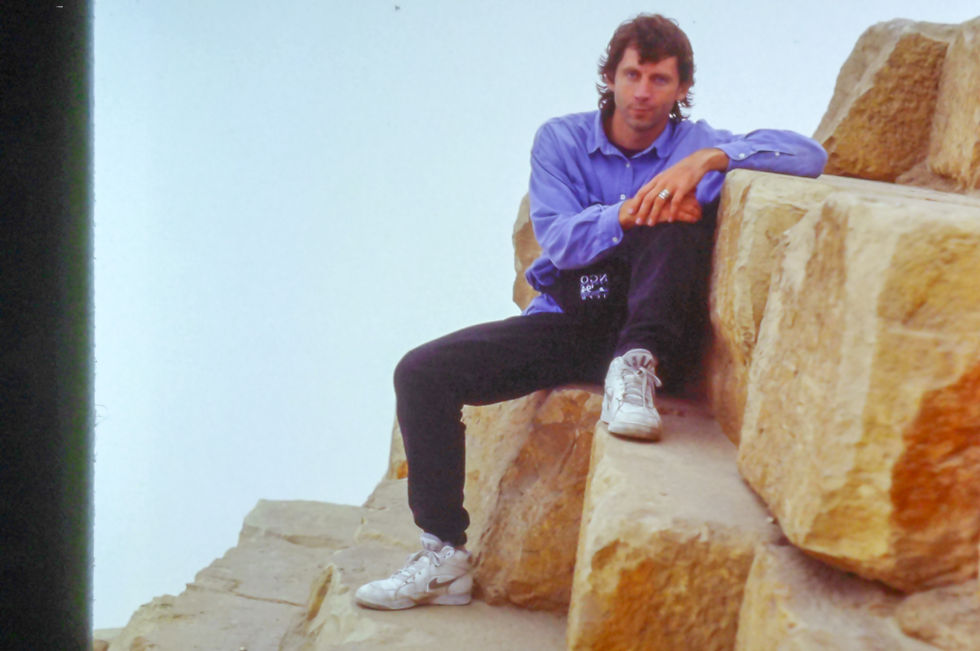
We stayed up through the night. Without the full moon, the sky was much darker than during my first climb, though far fewer stars were visible because of the haze and pollution rising from the vastly expanded city below. Cairo seemed much bigger than it had ten years earlier.
Just before dawn, the Fajr call to prayer once again began echoing across the darkness — first from one distant mosque, then another much closer, followed by dozens more joining together in clear, haunting, operatic voices:
“Aṣ-ṣalātu khayrun mina n-nawm.”
Prayer is better than sleep.
This time, when Ra presented himself, a thick mist had rolled in from the Nile Valley, completely enveloping the pyramids and the city below. In ancient Egyptian belief, Ra — the sun god — journeyed through the underworld each night before being reborn at dawn. Watching the sunrise from atop the Great Pyramid, it was easy to understand how such beliefs emerged.
We were standing above the clouds on the summit of Cheops, watching the rebirth of a new day from an island in the sky. As the sun climbed higher, the fog slowly dissolved, revealing Cairo and the desert beneath us.
Knowing security might eventually come looking for us — and also realizing we badly needed showers before returning to the conference — we scrambled quickly down the western side of the pyramid, staying as much as possible in shadow.

About half an hour later, we reached the bottom, just as a vendor on horseback approached carrying souvenirs for sale. My instinct was to wave him away, but Q had another idea. He greeted the man warmly and politely, asking about his wares.
Moments later, security guards rushed toward us and began speaking rapidly to the vendor in Arabic. The man answered calmly. The guards looked at us, hesitated, then walked away.
“What did they ask?” I said once they were gone.
“They wanted to know if you came down from the pyramid,” he replied casually. “I told them no — that you had just arrived from your hotel.”
We gave our new friend a generous tip, thanked him profusely, and hurried out through the gates to find a taxi.
Conference Breakthrough
After showers and a change of clothes, we returned to the conference just in time for the good news.
While we had been gone, a compromise had finally been reached. The final Cairo Programme of Action stopped short of declaring abortion an international right, but strongly endorsed universal access to reproductive health services, voluntary family planning, maternal health care, and women’s education. The conference marked a major turning point in global development thinking, shifting away from coercive population-control policies toward a rights-based approach centered on women’s health and empowerment.
Today, the “Cairo Consensus” is still considered a watershed moment in international development policy, even if many of the same debates remain politically charged more than thirty years later.
What history has never properly considered, however, is whether two sleep-deprived advocacy journalists, standing atop the Great Pyramid all night to redirect its energy toward the conference center, may have played a small role in breaking the deadlock.


Like my writing? Buy my book! Amazon.com // Amazon.ca // Amazon.co.uk // Anywhere


Comments